







AR Reality Perception
 |
System Introduction |
To address the limitations of traditional methods in obtaining road traffic information, providing weak overall control over traffic areas, and presenting resources in a less intuitive way, AR (Augmented Reality) fusion technology is employed to achieve a full-dimensional display of the traffic world, making what is perceptible truly visible.
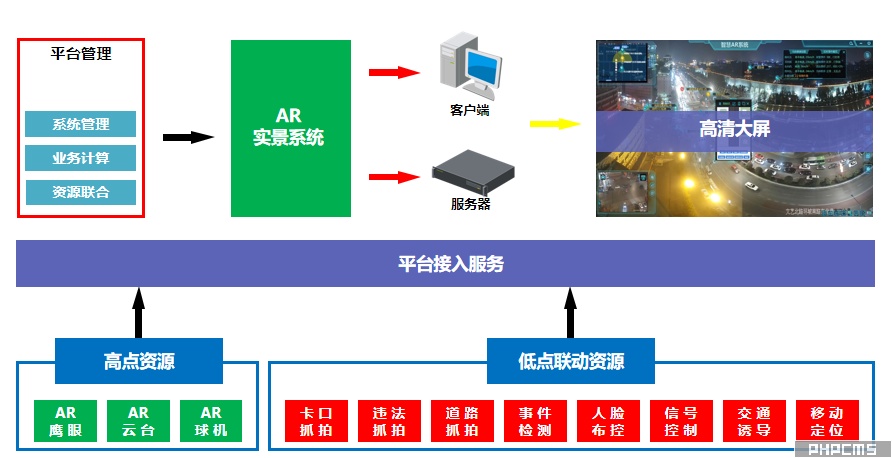
The AR real-scene perception system fully utilizes technologies such as augmented reality, 3D positioning, and artificial intelligence (pattern recognition, event detection, vehicle tracking, etc.). It acquires panoramic video from monitoring points through AR high-point panoramic cameras and links it with low-point cameras within the field of view. This enables large-scale, three-dimensional monitoring and video linkage, focusing on both the overall picture and specific details. It can display low-point camera video in a picture-in-picture format, making it queryable, searchable, locatable, descriptive, alarm-enabled, and linkage-enabled, greatly improving the application mode of the monitoring system and increasing practical efficiency.
| |
System Composition |
The AR Eagle Eye front-end combines video surveillance and AR intelligent applications, offering multiple functions in one device.

Depending on the application scenario, front-end products can be divided into AR Eagle Eye, AR high-altitude PTZ, and AR PTZ cameras. AR front-ends not only deliver an exceptional video viewing experience but also integrate AR intelligent applications, enabling the fusion of AR tags with video, integrating AR tags into the video stream in real time. The AR Eagle Eye device consists of a panoramic camera and a PTZ camera, providing both 180° panoramic and close-up views simultaneously, capturing both the overall picture and details.
Depending on the application scenario, front-end products can be divided into AR Eagle Eye, AR high-altitude PTZ, and AR PTZ cameras. AR front-ends not only deliver an exceptional video viewing experience but also integrate AR intelligent applications, enabling the fusion of AR tags with video, integrating AR tags into the video stream in real time. The AR Eagle Eye device consists of a panoramic camera and a PTZ camera, providing both 180° panoramic and close-up views simultaneously, capturing both the overall picture and details.
Intelligent perception is fundamental for front-end systems, enriching and refining intelligence perception capabilities.
Traffic management is becoming increasingly complex, with more and more factors influencing traffic conditions. Traffic management is no longer solely focused on vehicles; pedestrians, motor vehicles, non-motorized vehicles, weather, and road infrastructure are all becoming key factors affecting traffic. Traditional perception algorithms, due to their relatively low computational complexity, suffer from limitations in the quality of the perceived data they generate. Fully adopting deep learning algorithms based on complex neural networks to extract information from images provides accurate, comprehensive, and efficient data support and decision-making basis for improving the efficiency of traffic management operations.
Tags serve as both data and business logic, enabling comprehensive regional control.
The AR-based real-scene command and control system links relevant data from various traffic management subsystems through tags. Based on the data associated with the tags, related business logic is presented, allowing for real-time visualization of regional traffic management through a panoramic interface.

Macro-level traffic condition presentation utilizes the large-scale monitoring capabilities of AR Eagle Eye to view traffic flow in real time. Simultaneously, it leverages intelligent applications of low-level resources, such as traffic event perception, abnormal vehicle perception, and abnormal personnel perception, to provide fine-grained intelligence. Whenever an anomaly occurs, the corresponding tag displays a real-time warning, enabling proactive traffic condition detection.
Connecting command and duty, the system presents duty resources in real time, such as police location, traffic signal operation status, and guidance screen display status. Based on traffic anomalies, relevant duty resources can be dispatched with a single click. For example, when traffic congestion occurs, the command center can dispatch nearby police officers to direct traffic in real time based on the congested road sections. It can also flexibly modify the content displayed on guidance screens to guide and divert traffic flow, and can invoke traffic control timing plans to address traffic congestion.
