






Smart road bollards
 |
System Introduction |
The intelligent road bollard system can present road traffic conditions in real time, accurately, and intuitively.
It will act as the intelligent eyes for traffic guidance beyond visual range on the road, effectively alleviating traffic congestion and improving the coverage and timely warning rate of automatic detection of operational safety incidents.
In low-visibility environments, artificial intelligence provides a set of highly visible dynamic trails to vehicles behind. These trails are synchronized with the vehicle's movement to meet the minimum safe vehicle separation distance requirements in adverse conditions. This effectively reduces the probability of road traffic accidents caused by fog and can also reduce or avoid road closures due to fog.
| |
System Composition |
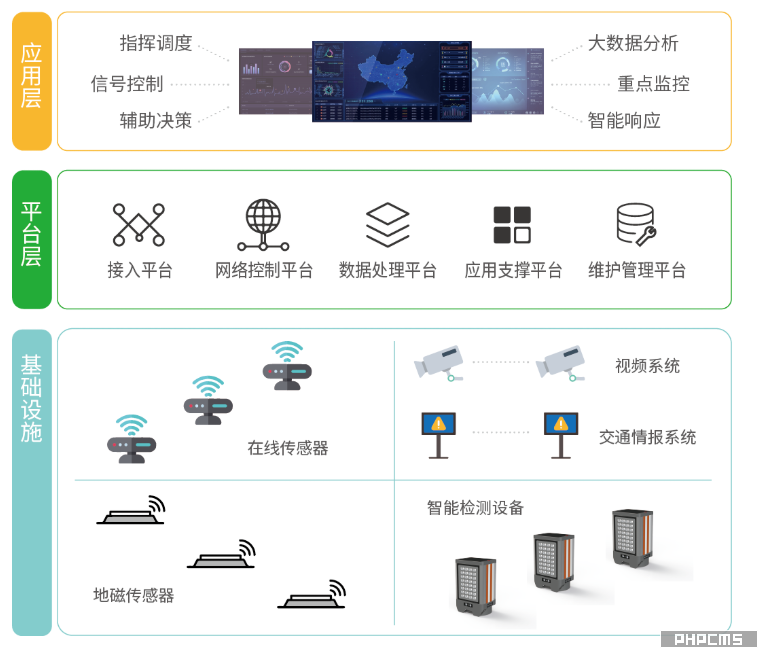
This system mainly consists of intelligent monitoring terminals and a platform. The intelligent monitoring terminals utilize advanced technologies such as video, radar, and laser, possessing multiple functions for sensing, transmitting, and interacting with road information, including detection, interaction, alerts, and guidance. Through various sensors, the terminals can transmit collected road condition information, weather information, and traffic flow information to vehicles, allowing drivers to receive advance notice and respond calmly to complex road conditions and emergencies. During information transmission, each terminal can transmit data to the back-end platform via a wireless network.
Fog Zone Guidance

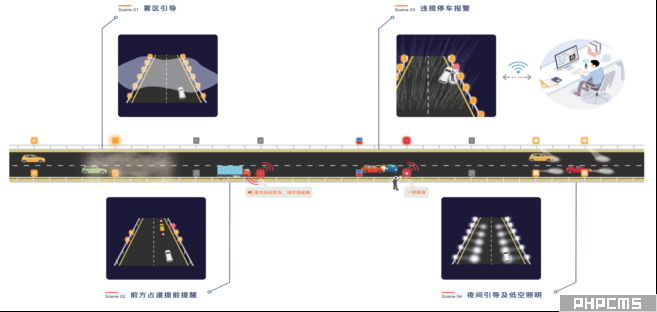
Fog has a significant impact on road traffic safety and highway network operations. Monitoring and early warning of dense fog, especially patchy fog, and ensuring vehicle safety en route are global challenges. This device features visibility and airborne particle detection capabilities. It can identify low-visibility environments such as fog or dense smoke and automatically activate directional flashing to guide vehicles, effectively preventing traffic accidents caused by low visibility.
It complies with the Ministry of Transport's JT/T1032-2016 technical requirements and standards for "Fog Weather Highway Driving Safety Guidance Devices." Its functions include a road contour enhancement mode, an active driving guidance mode, and a rear-end collision prevention warning mode. The LED light panel's synchronous flashing frequency, brightness, and red warning zone length are all adjustable.
Meteorological monitoring and early warning for road sections
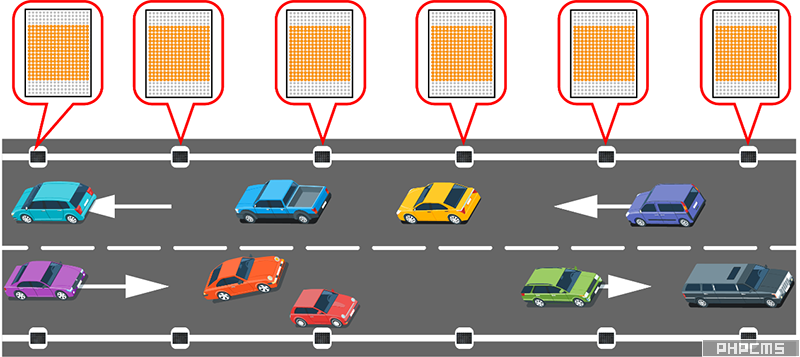
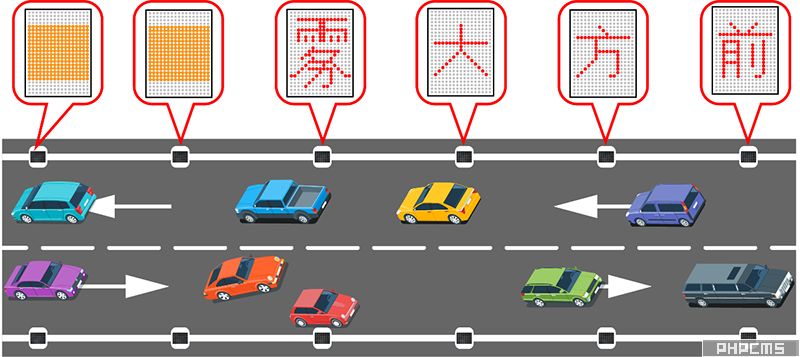
The fog guidance area shall be arranged in accordance with the technical requirements and standards of the Ministry of Transport JT/T1032-2016 "Fog Weather Highway Driving Safety Guidance Device". The equipment spacing in the warning information interaction area can be one device per direction, taking into account the actual road conditions.
Emergency lane warning
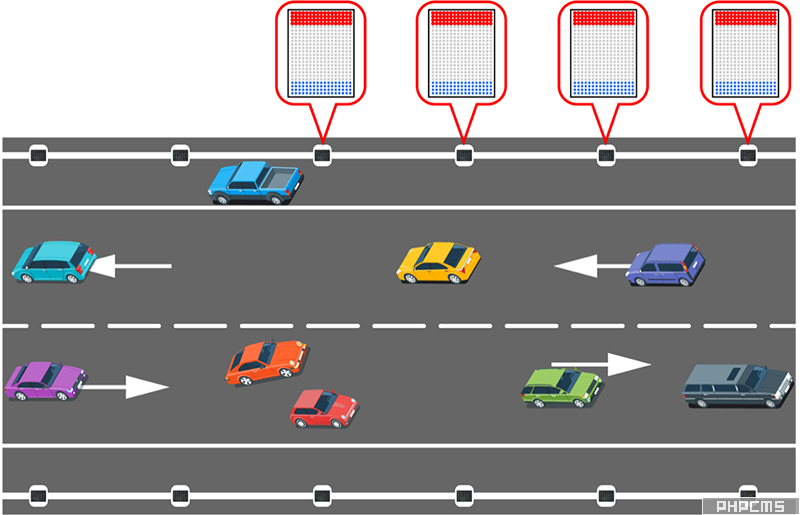
When the emergency lane is blocked or the emergency alarm button is pressed, nearby LoRa network devices will automatically activate a red, yellow, and blue strobe warning mode to alert following vehicles to drive safely. Simultaneously, they can provide images of the road conditions to confirm the situation. The emergency lane warning system also functions as a fence monitoring function, enabling real-time monitoring of illegally entering objects. When a person or organism crosses the fence or road, the device will immediately issue an alarm and automatically activate the warning mechanism. Additionally, it can use an internal accelerometer to monitor whether the fence is tilted or damaged in real time and return the data.
The device placement can refer to the standards for road construction warning facilities, or consider the actual road conditions, with one device every 25 or 50 meters in one direction.
Low-altitude lighting guidance
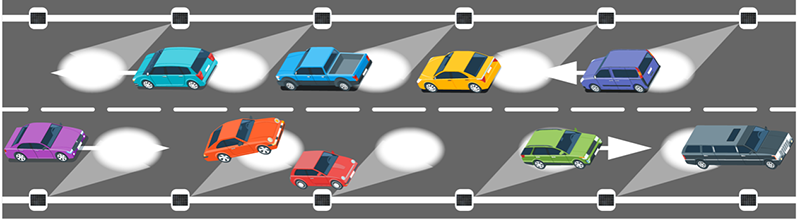
In some coastal sections, rural roads, and mountainous areas where nighttime visibility is severely insufficient, there is a complete lack of auxiliary lighting for safe driving. The equipment uses sensors to detect vehicles approaching and activates low-altitude lighting in the direction of travel. As the vehicle is about to completely pass through the illumination range of this equipment, the next equipment has already detected the vehicle and activated its low-altitude lights, while the first equipment turns off its lights. This relay lighting system ensures sufficient light for vehicles during their journey. This ensures normal vehicle passage while effectively avoiding light pollution. The equipment placement can refer to the standards for road construction warning facilities, or consider the actual road conditions, with one unit every 25 or 50 meters in one direction.
Information exchange and publishing
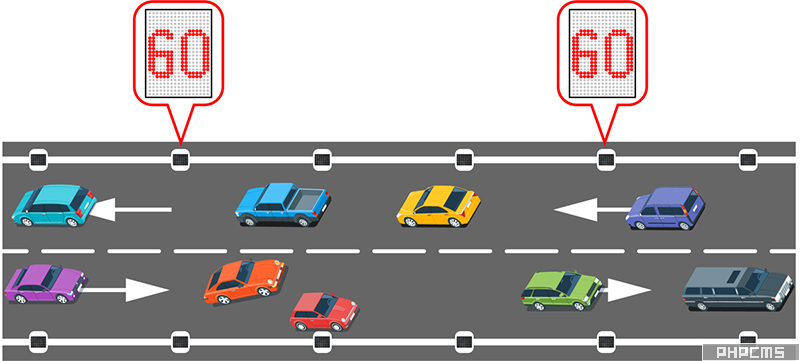
The equipment can display Chinese characters and numbers. When there are no road information display signs, it can sequentially scroll through Chinese characters to display information to road users through a grouping method. It can be implemented based on applications such as fog guidance, road section weather monitoring and early warning, emergency lane early warning, and low-altitude lighting guidance, and can also be freely deployed according to different road conditions and requirements.