







Intelligent highway maintenance
 |
System Introduction |
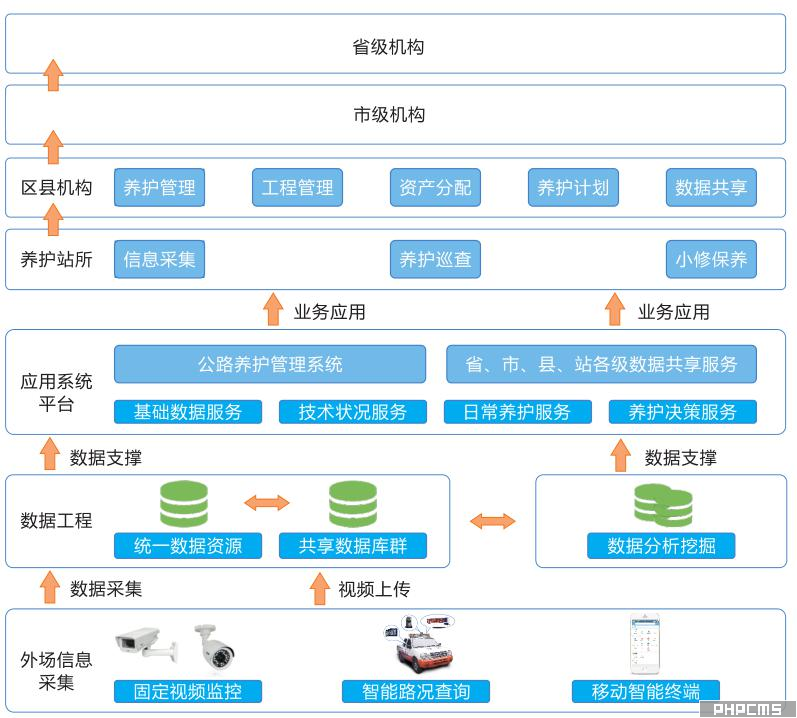
The "Highway Maintenance Management System Platform" fully utilizes GIS to provide information-based management and visual display of all road assets (roads, bridges, culverts, tunnels, etc.) along the entire highway network within its jurisdiction. Focusing on highway maintenance decision-making, daily maintenance management, and emergency response, it strengthens the construction and application of core business systems for highway maintenance management. Utilizing wireless networks and intelligent devices, it achieves efficient and accurate road patrols, real-time monitoring of important road sections, and assists in daily management, combining traditional work methods with internet thinking to realize information-based management of highway maintenance.
| |
Overall Structure |
Server-Side Database

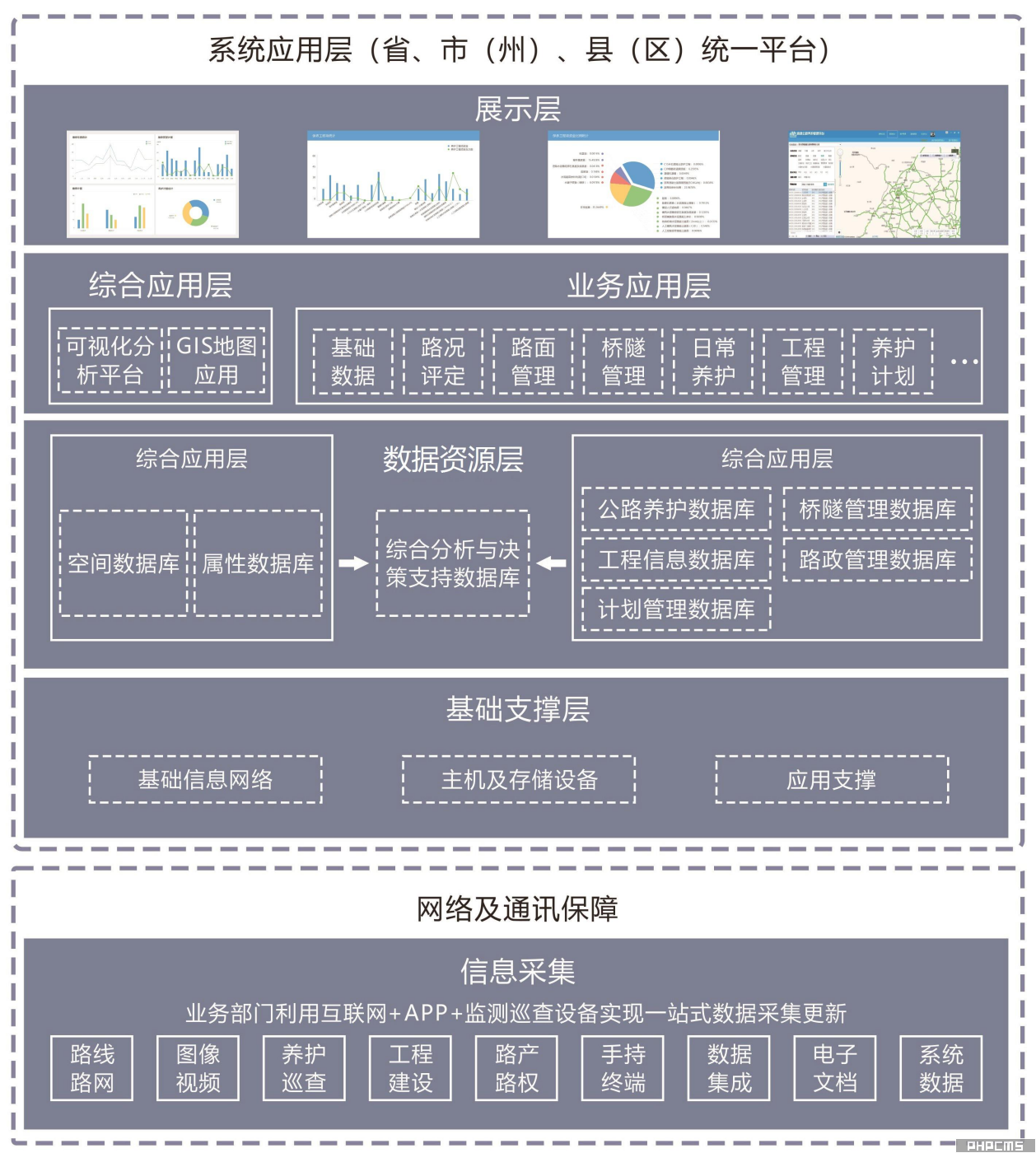
The technical architecture of the highway maintenance management system platform is shown in the diagram below. Data is processed from bottom to top, including the information acquisition layer, basic support layer, data resource layer, application layer, and presentation layer.
The system server, as the information processing and storage center of the entire platform, is the foundation for the secure operation of all platform data.
Highway Basic Database Construction
The platform's data consists of two main parts: First, fixed static data on all routes, structures, and facilities under the management of the maintenance unit—that is, road assets. This data needs to be collected and entered into the system before any action can be taken. This ensures both a clear understanding of road assets and the normal operation of the system.
Second, dynamic data generated during routine maintenance work (inspections, minor repairs, construction, etc.). This data needs to be registered and reported by maintenance personnel through the app during daily inspections to generate any business.
Maintenance Information Platform (PC Version)
The road maintenance information platform comprises multiple functional application subsystems, including map query, highway basic data management, daily maintenance management, bridge and tunnel management, maintenance project management, statistical business management, highway technical condition assessment management, emergency management, monitoring management, important road section management, mechanical maintenance center management, and system management.
The platform not only integrates road asset data, daily business processing, and maintenance project management, but also connects data from field intelligent equipment to the platform for unified management. For example, data from intelligent patrol vehicles is integrated with daily patrol registration, and data from intelligent cameras is integrated with monitoring management. When an event occurs, trigger signals are pushed to the information platform for daily patrols and emergency management, assisting road managers in decision-making.
Mobile App
The mobile app not only possesses the functions of the PC version but also offers the advantages of mobile office capabilities. Frontline inspectors can use the app to perform functions such as defect inspection, bridge and tunnel inspection, attendance management, data query, photo taking, and reporting to the central server during their inspections.
(1) Defect Inspection: During routine inspections, defects, disasters, and structural damage discovered on highways can be registered and reported on-site via the mobile app system. The data is simultaneously displayed on the PC, and registration can also be performed on the PC.
(2) Attendance Management: Functions include task assignment for field personnel, GPS location attendance tracking, and historical trajectory query.
(3) Task Order Processing: New task order generation and pending task order query enable mobile office capabilities.
Key Area Monitoring SystemSmart cameras are installed to monitor key areas such as bridges, slopes, and geological hazard points. Based on a centralized management strategy using a distributed system, a layered structure is adopted, logically divided into three layers: front-end subsystem, transmission subsystem, and back-end management subsystem. The high-definition monitoring front-end enables 24/7 uninterrupted monitoring of important road sections, responsible for high-definition video image acquisition, encoding, compression, and image uploading of road cross-sections. The network transmission subsystem enables interconnection between the front-end devices and the back-end management system. According to relevant business needs, the monitoring video images are connected to the monitoring center and maintenance information platform, and alarms are triggered in the event of an incident.
Vehicle-mounted video inspection system
The vehicle-mounted video patrol system is a new era product for intelligent road patrol. Its biggest features are intelligent daily patrols and information-based emergency command. The application of this system has brought daily road patrol work into the era of image information management, including patrol vehicle trajectory management, full visibility of the patrol process, and a patrol defect reporting system. Emergency images can not only be transmitted in real time to the production scheduling (emergency) monitoring and command center, but can also be viewed in real time on computers and mobile phones.
Unmanned aerial vehicle (UAV) mobile patrol system
By equipping drones with high-definition cameras, audio modules, and network transmission modules, drones can be deployed on highways to transmit real-time video and audio data to the control terminal and back to the existing video monitoring center. This enables a flexible and mobile video monitoring method for daily road condition monitoring, highway patrol and maintenance, highway information collection, and emergency response.
