






Integrated Information Management System for Transportation Administrative Law Enforcement
 |
System Introduction |
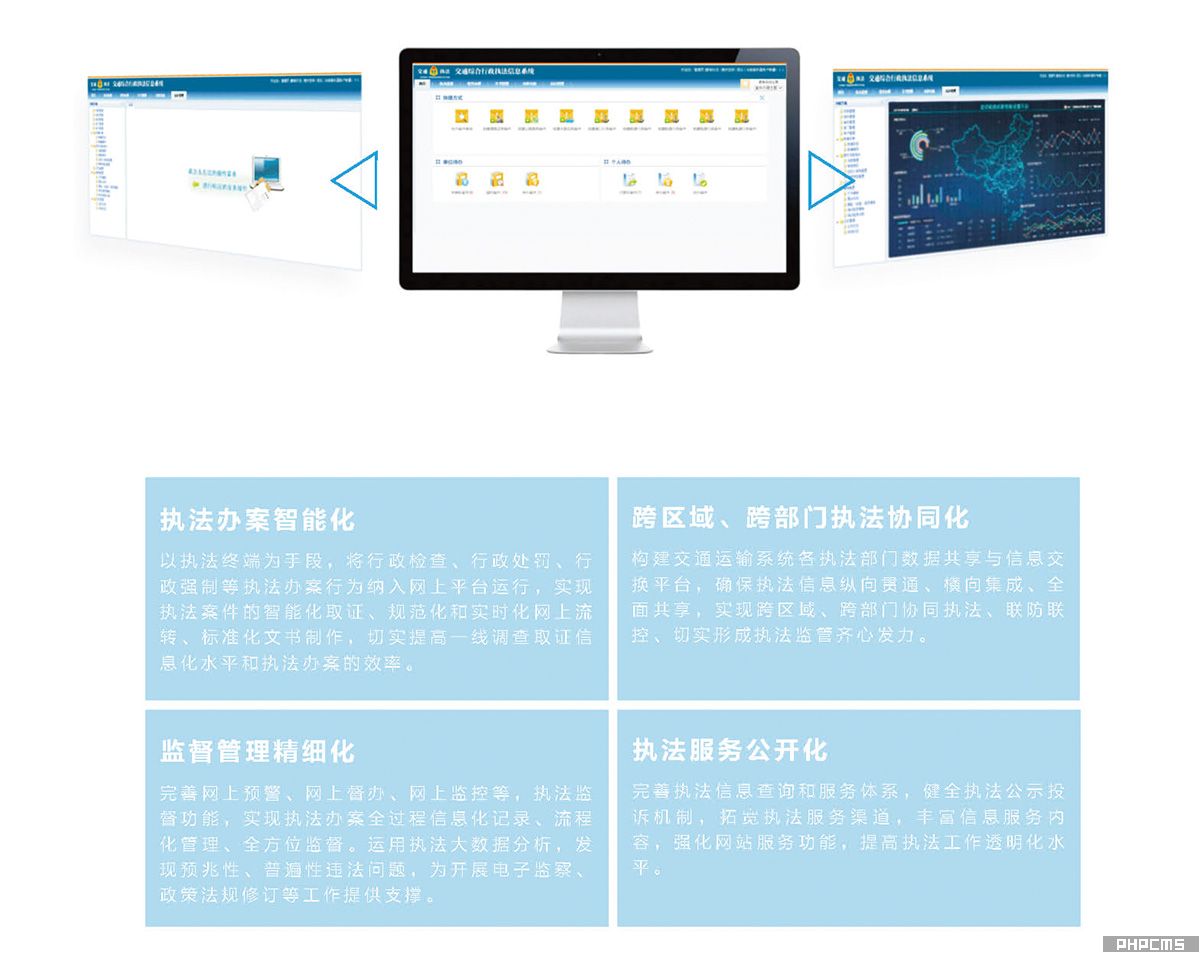
The Comprehensive Management Information System for Transportation Administrative Law Enforcement is a key informatization construction project proposed in the "13th Five-Year Plan for the Development of Transportation Informatization." The system design conforms to the standards of the "Construction Guidelines for the Comprehensive Management Information System for Transportation Administrative Law Enforcement" issued by the General Office of the Ministry of Transport. It focuses on law enforcement case handling, law enforcement team building, law enforcement supervision, and law enforcement services, constructing a comprehensive transportation law enforcement informatization system characterized by "vertical integration, horizontal integration, information sharing, business collaboration, and intelligent convenience." The Yiwei Comprehensive Management Information System for Transportation Administrative Law Enforcement covers the law enforcement operations of six major functional departments: highway administration, road transport administration, waterway transport administration, waterway administration, port administration, and maritime administration. It improves the informatization level of comprehensive administrative law enforcement departments, addresses the previous problems of low efficiency, numerous procedures, long processing times, and unclear law enforcement boundaries, enhances the decision-making support capabilities of law enforcement management departments, strengthens the efficiency of government management services, and achieves the goals of standardized law enforcement team management, intelligent law enforcement case handling, cross-regional and cross-departmental law enforcement collaboration, refined supervision and management, and high-quality law enforcement services.
| |
System Module |
Administrative Law Enforcement Management System
This system manages the entire administrative law enforcement process, from case filing and approval to enforcement and case closure. It mainly includes modules for law enforcement document management, discretionary power system, handling of administrative penalty cases, notification of assistance in investigations, administrative reconsideration, notices of reminder, law enforcement supervision and management, fine payment management, and query and printing.
Law Enforcement Supervision System
Law enforcement supervision and management includes on-site supervision and operational supervision. On-site supervision utilizes multimedia information such as video and audio from individual equipment used by law enforcement vehicles and field personnel to monitor the entire process of on-site law enforcement. Functions include video surveillance and monitoring of the movement trajectory of field personnel.
Operational supervision includes real-time supervision, discretionary power supervision, case process supervision, case processing time limit supervision, case processing result supervision, case spot checks, filing and supervision of major cases, and annual law enforcement evaluation and assessment.
Law Enforcement Personnel Management System
This system establishes electronic files for law enforcement agencies and personnel, achieving closed-loop information management of personnel qualifications, training, examinations, qualification approval, law enforcement certificates, and law enforcement authority. The functions include management of law enforcement personnel and their credentials, online examination management for law enforcement personnel, online training management for law enforcement personnel, daily performance management, and management of law enforcement equipment.
Intelligent Law Enforcement Terminals
Constructing non-site law enforcement detection systems such as intelligent detection of overloaded vehicles and electronic evidence collection for important road sections, key bridges and tunnels, ports, and waterways. Equipping vehicle-mounted (ship-mounted) and handheld law enforcement information terminals to achieve comprehensive inspection and automatic identification of illegal activities, improve the intelligence level of on-site law enforcement monitoring and evidence collection, reduce on-site law enforcement, and avoid law enforcement conflicts.
Information Sharing and Exchange System
Constructing an information sharing and exchange platform in accordance with the "Requirements for Law Enforcement Data Collection and Interactive Service Interfaces" to achieve information sharing within the transportation administrative law enforcement system, within the transportation industry, and outside the industry. The platform mainly includes data access management, sharing and exchange management, data service management, intra-system exchange and sharing, intra-industry sharing, and inter-industry sharing.
Enforcement Data Analysis System
Based on transportation administrative enforcement data, this system analyzes key regulatory areas and weak links within its jurisdiction to optimize enforcement supervision and duty arrangements, effectively allocate enforcement resources, and achieve precise supervision and governance. Information analysis functions include: intelligent analysis of speeding, long-duration driving, illegal driving in the wrong direction, driving in prohibited areas, accident analysis, and violation analysis for passenger vehicles and hazardous material transport vehicles.
Mobile Enforcement Comprehensive Management
Through mobile enforcement terminals, this system enables mobile case handling, management, and training. It facilitates information collection from regulated entities, supervision of case handling by enforcement agency managers, process approval, case spot checks, statistical analysis, and information push and reminders.
Information Disclosure and Services
Through mobile enforcement terminals, this system enables mobile case handling, management, and training. It facilitates information collection from regulated entities, supervision of case handling by enforcement agency managers, process approval, case spot checks, statistical analysis, and information push and reminders.
